
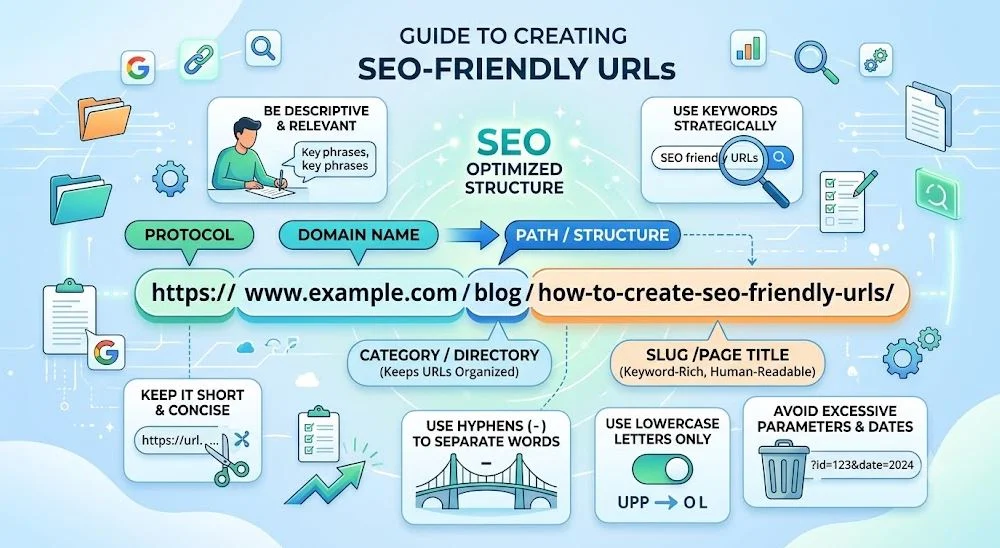
SEO Friendly URL’s
An illustration of this is exemplified by the webpage URL of example.com/how-to-create-seo-friendly-urls being more aligned to the way a user would vocally question anything in order to create more search… Your content’s quality, design and design, along with technical performance are often the subject of debate. One thing that is often ignored and is often neglected can be the design of your site. URLs aren’t only used to display your content. They’re also indicators that influence the way search engines see the content you have on your site and the way visitors perceive the image of your site. A properly-constructed, keyword-rich URL improves the ranking of your site and also improves the number of clicks and improves the quality of your customers’ satisfaction.
Why SEO-Friendly URLs Matter
Google and other engines use URLs to determine the content of a website. A clear URL can show users that they’re on the right website.
- Right Example: example.com/seo-friendly-urls
- Wrong Example: example.com/post?id=12345
The first one is simple and concise, with a particular focus on key terms, and is easy to recall. The second one is more unclear and doesn’t help the user, and can be difficult for engines such as Google to understand. Google-friendly websites boost the number of click-throughs thanks to the fact that users are more likely to choose websites that look genuine and worth their time. They will enhance your user experience by making it easier to share and remain at the forefront of your customers and users. They also help improve web pages’ structure, and assist search engines to index and crawl websites more efficiently.
Website Content Structure for SEO
Title : How to Create SEO-Friendly URLs in WordPress
- Meta Description – Learn creating SEO-friendly URLs using WordPress. Discover the most effective methods to put keywords in the correct position and boost the amount of URLs’ reach.
- Internal Linking Links which link to other internet websites that are relevant to the subject. This is the most effective method of creating SEO-friendly blogs. it’s also the best way to integrate SEO terms into WordPress.
- External Links Search for reliable sources, like Google’s SEO Starter Guide.
- Image Optimization: Use alt text For instance “SEO-friendly URL example ” in WordPress settings. “
- Schema Markup Schema FAQs offer answers to queries such as “What is what an SEO appropriate URL appears like? ” and “How can I modify URLs on WordPress? “
Include Relevant Keywords
SEO relies on Keywords to be effective. If you use relevant keywords in your URL structure the URLs will help users understand what your site is about as well as help search engines quickly identify and categorize pages based on the keywords in your URL.
- Good: example.com/wordpress-seo-plugins
- Bad: example.com/article-2456
Do not be afraid of sites with a lot of words. One keyword suffices. If you’re using many synonyms, the quality of your text. Instead, pay attention to the quality of your text and make use of synonyms and other words which are related with the content.
Keep URLs Short and Clear
Longer URLs may make it difficult for users to share them, understand as well as to remember. It is recommended to limit URLs to between three and five words.
- Simple and concise: example.com/seo-tips
- Long and Congested: example.com/how-to-create-seo-friendly-urls-for-wordpress-2026
Short URLs can enhance the user experience and lower the likelihood of short URL appearing in results of a search.
Use Hyphens for Separation
Hyphens are a way to create unique URLs. Google interprets space using hyperbola, making the URLs easier to comprehend.
- Correct: example.com/seo-friendly-urls
- Incorrect: example.com/seo_friendly_urls
Do not use underscores or spaces along with other characters as they can cause confusion for Internet users.
Remove Unnecessary Words
Words like “and,” “the,” or “of” should be removed
- Better: example.com/seo-friendly-urls
- Bad: example.com/how-to-create-the-best-seo-friendly-urls
Optimize URL Slugs
It’s possible to utilize the Slug. It is essential to alter Slugs to make sure they’re appropriate for the terminology you’re trying to find.
For example, if your post title is “10 Tips for Creating SEO-Friendly URLs in WordPress,” the default slug might be example.com/10-tips-for-creating-seo-friendly-urls-in-wordpress. A better slug would be example.com/seo-friendly-urls. Plug-ins such as Yoast SEO and plug-ins such as Yoast SEO along with the Rank Math let you optimize URLs. They can also assist in enhancing URLs so that you get the most effective results.
Avoid Special Characters
Certain characters like = or /or can result in URLs to appear messy and cause indexing problems. It is essential to make use of numbers, letters and hyphens.
- Clean: example.com/seo-basics
- Messy: example.com/seo?id=123&ref=abc
Common Mistakes to Avoid
- Keywords that are too full of words, as well as the huge quantity of words that are used in URLs is usually difficult to understand.
- URLs are usually changed frequently. The changes to URLs that remain consistent even if they’re not containing redirects could harm the hyperlinks.
- URLs with uppercase letters must be cut down to prevent duplicate issues.
- Long slugs could reduce visibility and may increase CTR.
- Be conscious of redirects. Inability to redirect 301s on a regular basis whenever you change URLs can lead to the loss of your site’s SEO.
Benefits of SEO-Friendly URLs
The top positions in search engine results are increased because of the accuracy and relevance of the keywords that appear in results. A more effective CTR is more effective and indicates that people who use the internet are more likely to find relevant websites. Improves user experience by providing simple and easy URLs that can be easily shared and accessible. Indexability has increased. That means, search engines can search more effectively for the information. Enhances consistency in URL structure, and enhances the image of your brand. aids in improving the image of your brand and enhances the perception of your company.
Advanced Strategies for 2026
AI-Driven URL Suggestions- AI instruments are able to determine the motivations of their users as well as provide suitable names for the names. For example, if your article is about portable EV chargers, AI may recommend example.com/portable-ev-chargers-uk instead of a generic slug.
Voice Search Optimization
Due to the growing use of search engines via voice and their growing popularity, URLs need to be able respond to questions that are asked in conversations. For example, example.com/how-to-create-seo-friendly-urls aligns with how users ask questions aloud.
Mobile-First Indexing
The requirement of Google to index mobile-friendly websites requires that URLs be responsive in order for speedier loading times. Simple URLs can boost the experience of mobile users, however they may limit the number of websites that users visit.
Conclusion
Making SEO friendly URLs are essential to optimize your website. Make use of the appropriate keywords and make sure that URLs are written clearly and contain the hyphens. This eliminates unnecessary characters or words that use lowercase letters, which will enhance the user experience and increase the results of a Google search. Making use of WordPress plugins like Yoast and Rank Optimizing URLs for Math is feasible even for those who do not have a good knowledge of the subject. The most important factor to be successful is the security of the site. URLs must clearly convey the necessary information and constantly the same throughout time.